


How to Drive in Snow and Ice: A Middle Tennessee Guide
The Quick Answer
Slow everything down: speed, acceleration, steering and braking. TDOT’s winter message is “In Ice and Snow: Take it Slow.” AAA recommends a five- to six-second following distance and no cruise control on slippery roads. Treat bridges and overpasses as icy first, and postpone non-essential trips when roads are bad. With antilock brakes, use firm, continuous pedal pressure rather than pumping.
Middle Tennessee does not see snow and ice every week of winter, which is part of what makes those days tricky. Many drivers get little practice, and a light glaze can change how a car stops and steers.
This guide pulls together advice from TDOT, the National Weather Service, NHTSA, AAA and Kia’s 2027 Telluride owner’s manual, checked Nov. 7, 2026.
In this guide
- What is the safest way to drive on snow and ice?
- How much following distance do you need on ice?
- Why do bridges freeze before roads?
- What is black ice?
- How do you drive up and down icy hills?
- How should you brake on ice?
- Should you use snow tires or chains?
- How do you get your vehicle ready before a winter storm?
- What do winter weather alerts mean for your drive?
- How do you check Tennessee road conditions before you go?
- Frequently asked questions
- Where can you get a winter check in Franklin?
- About the Author
- References
What is the safest way to drive on snow and ice?
Slow down and make every input gentle. TDOT and the Tennessee Highway Patrol sum it up as “In Ice and Snow: Take it Slow,” meaning slower speeds, acceleration, steering and braking.
Kia’s manual says speeding, rapid acceleration, sudden braking and sharp turns are potentially very hazardous on snowy or icy roads, and that sudden braking can cause skidding.
- Accelerate slowly: AAA says applying the gas slowly helps you regain traction and avoid skids.
- Slow down early: it takes longer to stop on icy roads, so give yourself time before lights and turns.
- Skip cruise control: AAA says not to use it on any slippery surface, such as ice and snow.
- Give plows room: NHTSA says not to crowd or drive directly beside a snowplow, and to use caution if you pass.
How much following distance do you need on ice?
Five to six seconds, according to AAA. That extra margin gives you the longer distance you need if you have to stop.
NHTSA agrees that you should increase following distance enough to have plenty of time to stop, because it is harder to control or stop a vehicle on a slick or snow-covered surface.
How do you count following distance?
Pick a fixed point such as a sign. When the vehicle ahead passes it, count the seconds until you reach the same point. If you get there before five or six seconds, ease off.
Why do bridges freeze before roads?
The National Weather Service warns that bridges and overpasses are particularly dangerous because they freeze before other surfaces.
Treat every bridge and overpass as potentially icy when temperatures are near freezing, even if the road leading up to it looks fine. Middle Tennessee commutes cross plenty of them.
What is black ice?
Patchy ice on a roadway that cannot easily be seen, according to the NWS. It is often clear, so the dark pavement shows through.
It is most common in the early morning, especially after melted snow refreezes overnight. It can also form when rain-slick roads freeze as temperatures drop below freezing overnight.
How do you drive up and down icy hills?
With momentum and patience. Hills and stops at the top of grades take extra planning. AAA advises:
- Do not power up hills. Extra gas on a snow-covered road just spins the wheels.
- Build momentum on flat ground before the hill and let it carry you up.
- Avoid stopping on the way up if you can.
- Slow down at the crest and go downhill slowly.
- Keep rolling when it is safe. It takes more effort to start from a full stop than to keep moving slowly.
How should you brake on ice?
Gently, early and with steady pressure. If your vehicle has antilock brakes, NHTSA says to apply firm, continuous pressure to the pedal. AAA likewise recommends firm, steady pressure with the heel of your foot on the floor.
Kia’s Telluride manual says not to pump the brake pedal on a vehicle with ABS. It recommends using engine braking fully when you slow down, keeping a sufficient distance and pressing the brake pedal gently.
Do AWD and chains prevent skids?
No. Kia says tire chains let you drive with greater force but do not prevent side skids. Equipment helps, but it does not replace slower speeds and gentle inputs.
What should you do if you start to skid?
Stay calm and ease off. The NWS says to take your foot off the gas and turn the wheels in the direction you want the front of the car to go. With ABS, apply steady pressure to the brake pedal rather than pumping it.
Should you use snow tires or chains?
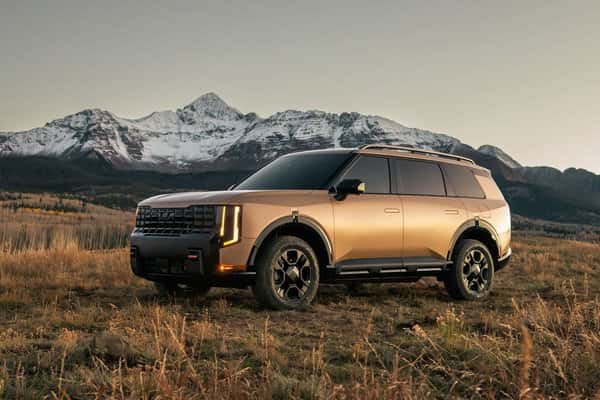
Kia’s 2027 Telluride manual recommends snow tires over chains, because certain chains can damage the thinner sidewalls of radial tires.
- Snow tires: radial tires of the same size and load range as the originals, on all four wheels. They may have lower traction than the originals on dry roads.
- Chains: on the Telluride, fabric-type chains for 18-, 20- and 21-inch tires, front tires only on AWD models, below 20 mph.
- Warranty: damage from improper tire chain use is not covered.
- Rules: tire chains are not legal in all states, so check state laws, and check regulations before installing studded tires.
Chain and tire rules vary by model, so check the winter section of your own owner’s manual.
How do you get your vehicle ready before a winter storm?
Start with tires, battery and visibility. NHTSA and Kia recommend:
- Tire pressure: pressure drops as temperatures fall. Inflate to the pressure on the driver’s door-frame label, not the number on the tire.
- Tread: at least 2/32 inch on all tires, per NHTSA. That minimum is not a guarantee of winter traction.
- Battery: cold reduces battery power, and EV and hybrid range can drop. Kia suggests having a dealer check the 12-volt battery’s charge.
- Wipers and fluid: fill the reservoir with winter fluid with de-icer and replace worn blades. Kia warns not to use engine coolant as washer anti-freeze.
- Coolant: Kia suggests testing the coolant before winter to make sure its freezing point suits expected temperatures.
- Fuel or charge: keep the tank close to full, or keep an EV charged. AAA says at least half a tank.
- Clear the whole vehicle: the NWS says to make sure it is completely clear of ice and snow before you leave, because flying snow from cars causes crashes.
- Warm up outdoors: AAA says never to warm up a vehicle in an enclosed area, such as a garage.
What winter problems can catch you off guard?
A few that Kia’s 2027 Telluride manual and NHTSA call out:
- Frozen parking brake: it can freeze when snow, ice or water builds up near the rear brakes. If that is a risk, apply it only briefly with the vehicle in P (Park), block the rear wheels, then release it.
- Ice under the fenders: buildup can interfere with steering, so check under the vehicle periodically in severe conditions.
- Frozen locks: use an approved de-icer or glycerin in the key opening.
- Floor mats: NHTSA says improperly installed mats can interfere with the pedals. Use the right size and secure them with retention clips.
- Car seats: heavy coats can interfere with harness fit. NHTSA suggests thin, warm layers, with blankets or coats placed over the child after the harness is snug.
What should be in a winter emergency kit?
NHTSA suggests a snow shovel, broom and ice scraper; sand or kitty litter for traction; jumper cables, a flashlight and warning devices; a first aid kit; blankets, water and non-perishable food; and a phone with a car charger.
What do winter weather alerts mean for your drive?
They tell you how seriously to take a trip. Your local National Weather Service office issues them using local criteria, and the NWS notes that the snow needed for a Winter Storm Warning in the Southeast is typically much lower than in the Northern Plains:
| NWS alert | When it is issued | What the NWS says to do |
|---|---|---|
| Winter Weather Advisory | Snow, ice, sleet or a mix expected, below warning level | Be prepared for winter driving conditions; use caution |
| Winter Storm Watch | Conditions favorable for a significant winter storm | Be prepared |
| Winter Storm Warning | A significant winter weather event; travel may become difficult or impossible | Delay travel until conditions improve |
| Ice Storm Warning | Usually about 1/4 inch of ice or more | Travel is strongly discouraged |
The NWS defines freezing rain as rain that freezes on contact, coating roads with ice, and sleet as ice pellets that can make wet roads slippery.
How do you check Tennessee road conditions before you go?
TDOT links to Tennessee 511 travel information and TDOT SmartWay for road conditions. Drivers who have trouble on the road can dial *THP to reach the Tennessee Highway Patrol.
NHTSA recommends postponing non-essential travel if roads are not in good shape. AAA suggests telling someone your route, destination and expected arrival time.
What if you get stuck or stall?
Stay with your vehicle, NHTSA says, make it visible and keep the dome light on. Clear snow from the exhaust pipe and run the engine only long enough to stay warm, to prevent carbon monoxide poisoning.
The NWS suggests running the motor about 10 minutes each hour for heat, with a window opened slightly for fresh air. AAA warns against walking away in a severe storm or overexerting yourself while digging out.
To free a stuck Telluride, Kia says to accelerate slowly in 2nd gear and use sand or another nonslip material under the drive wheels. Do not spin the wheels, especially above 35 mph, and have the vehicle towed if a few tries do not work.
Frequently asked questions
How much following distance do you need on snow and ice?
AAA recommends increasing your following distance to five to six seconds on snowy or icy roads.
Why do bridges freeze first?
The National Weather Service says bridges and overpasses are particularly dangerous because they freeze before other surfaces.
When is black ice most common?
The NWS says black ice is most common in the early morning, especially after melted snow refreezes overnight. It can also form when wet roads freeze.
Should you pump antilock brakes on ice?
No. NHTSA says to apply firm, continuous pressure with antilock brakes, and Kia’s manual says not to pump the pedal on a vehicle with ABS.
Should you use cruise control on icy roads?
No. AAA says not to use cruise control on any slippery surface, such as ice and snow.
What is the difference between a winter storm watch and a warning?
The NWS issues a watch when conditions are favorable for a significant winter storm, and a warning when one is expected and travel may become difficult or impossible.
Where can you get a winter check in Franklin?
Before winter weather arrives, our service team at Greenway Kia of Franklin can check your tires, battery, wipers and fluids. Call service at 615-236-3210 or sales at 615-538-1124.
About the Author
This guide is from the sales and service team at Greenway Kia of Franklin, 1413 Murfreesboro Road, Franklin, TN 37067. The dealership’s website describes it as a Franklin Kia dealership serving the Nashville area, Madison, Murfreesboro, Brentwood and Spring Hill.
It was compiled from TDOT, National Weather Service, NHTSA and AAA guidance and Kia’s 2027 Telluride owner’s manual. It does not report independent testing.
References
Tennessee Department of Transportation: Ice & Snow — https://www.tn.gov/tdot/engineering-operations-division/inclement-weather/ice-snow.html
National Weather Service: Ice Storms — https://www.weather.gov/safety/winter-ice-frost
AAA Exchange: Winter Driving Tips — https://exchange.aaa.com/safety/driving-advice/winter-driving-tips/
NHTSA: Winter Weather Driving Tips — https://www.nhtsa.gov/winter-driving-tips
Kia Owner’s Manual, 2027 Telluride: Winter driving — https://ownersmanual.kia.com/full_webhelp/LQ2/2027/en_US/topics/t00412.html
Kia Owner’s Manual, 2027 Telluride: Special driving conditions — https://ownersmanual.kia.com/full_webhelp/LQ2/2027/en_US/topics/t00411.html
National Weather Service: Winter Weather Warnings, Watches and Advisories — https://www.weather.gov/safety/winter-ww
National Weather Service: During a Winter Storm — https://www.weather.gov/safety/winter-during
Greenway Kia of Franklin: Kia Dealer & Pre-Owned Car Sales – Franklin TN — https://www.greenwaykiafranklin.com/
0 comment(s) so far on How to Drive in Snow and Ice: A Middle Tennessee Guide